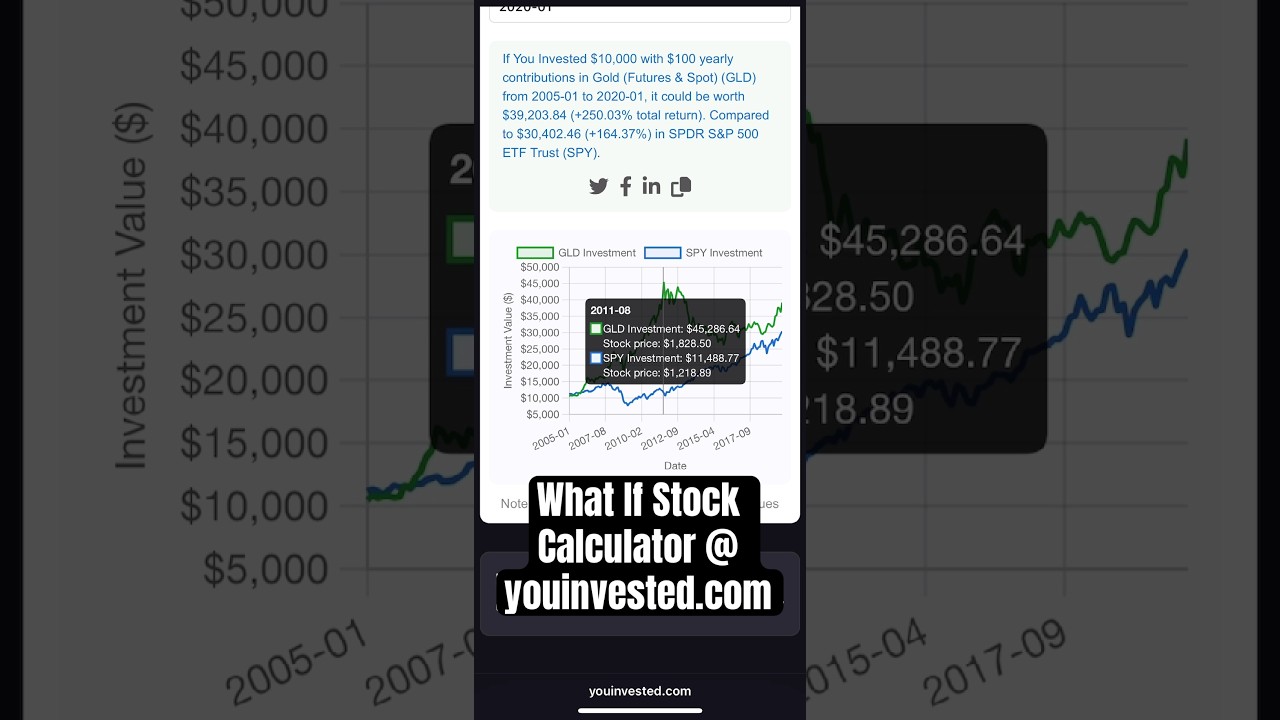
Ever wonder "What If?"β€”Use our "What If" Stock Calculator to analyze one of the most dynamic 40-year periods in market history (1985-present). See how hypothetical investments with monthly or yearly contributions in 100 iconic stocks would have performed through crashes, booms, and technological revolutions. Turn hindsight into insight and discover how regular investing can significantly impact your returns over time.

Travel Back To Invest In The Future.

"What If" Stock Calculator

i

Note: Data points represent end-of-month values

Watch a Demo

See how to use this stock calculator to explore "What If" investment scenarios and analyze historical stock performance.

10 "What If" Scenarios

1. The Newborn's Nest Egg

See how a one-time $100 investment for a newborn could grow by their 18th birthday. This illustrates the power of long-term compound growth for a child's future.

2. The First Paycheck Principle

What if you invested just $50 from your very first paycheck? A small start can demonstrate the benefit of starting to invest early in your career.

3. The Graduation Gift Fund

Analyze the potential growth of investing your high school or college graduation money instead of spending it, setting up a financial head start.

4. The Annual Bonus Boost

Instead of treating it as just extra cash, see how investing your annual work bonus each year could have accelerated your wealth building.

5. The "Quit a Habit" Reward

Saving $5 a day on coffee is $150 a month. See how investing that "found money" could create significant returns over several years.

6. The Tax Refund Strategy

A tax refund can feel like a windfall. This scenario shows the long-term impact of investing that money versus spending it right away.

7. The Side Hustle Snowball

The first $1,000 from a side hustle is a huge milestone. See how investing that initial seed money could grow into a serious asset.

8. The Milestone Birthday Marker

Commemorate a big birthday (like your 30th or 40th) by seeing how a one-time investment could have matured by your retirement.

9. The Wedding Gift Growth Plan

See how investing cash gifts from a wedding could grow over the first 10 years of marriage, building a foundation for the future.

10. The "Old Tech" Trade-In

What if instead of buying that $500 games console in 2005, you had invested it in a tech company? A powerful look at consumer spending vs. investing.

10 Essential Stock Tips

1. Learn from Market Cycles

πŸ”„+

History shows markets move in cycles (e.g., booms like the 1920s or crashes like 1929 and 2008). Study past cycles to recognize patterns and avoid buying at peak euphoria or selling in panic.

2. Invest in Quality Companies

🏒+

Historical successes like Coca-Cola or IBM show that companies with strong fundamentals (consistent earnings, solid balance sheets) tend to outperform over decades.

3. Embrace Long-Term Holding

⏳+

Investors like Warren Buffett, who held stocks like GEICO for decades, demonstrate that long-term ownership of great businesses beats frequent trading.

4. Diversify to Mitigate Risk

πŸ“Š+

The 2000 dot-com bubble taught that over-concentration in one sector (tech) can be disastrous. Spread investments across industries to mirror the resilience of balanced portfolios.

5. Avoid Market Timing

⏰+

Historical attempts to time the market, like during the 1987 crash, often failed. Consistent investing through dollar-cost averaging has proven more reliable.

6. Beware of Speculative Bubbles

πŸ’₯+

The South Sea Bubble (1720) and more recent crypto surges highlight the danger of chasing overhyped assets. Stick to investments with intrinsic value.

7. Focus on Dividends

πŸ’Έ+

Historically, dividend-paying stocks like those in the S&P 500 have provided steady returns, especially during volatile periods like the 1970s inflation crisis.

8. Understand Economic Context

🌎+

Events like the Great Depression or stagflation in the 1970s show that macroeconomic factors (inflation, interest rates) impact stocks. Stay informed about economic trends.

9. Learn from Past Mistakes

⚠️+

The 2008 financial crisis exposed the risks of over-leveraging. Avoid borrowing heavily to invest, as markets can turn unpredictably.

10. Stay Disciplined

🧠+

Legendary investors like Benjamin Graham, who thrived through volatile markets, emphasized discipline. Create a plan based on historical principles and stick to it, ignoring short-term noise.

Frequently Asked Questions

Get instant answers about our "What If" Stock Calculator and how it can help you make wise and informed decisions.

Our stock investment calculator uses real historical data for 100 major stocks and automatically adjusts date ranges based on when each stock actually became available for trading. Unlike calculators that use hypothetical returns or require manual date selection, our interactive tool intelligently sets the earliest investment date for each stock - for example, Tesla automatically starts from 2010 when it went public, while established companies like Coca-Cola can show results for that same time period. So you can compare side by side. You simply enter a lump sum investment amount and see what it would be worth today using actual historical performance.

Our smart calculator automatically adjusts the investment timeline based on each stock's actual trading history. When you select a newer stock like Tesla (public since 2010) or Netflix (public since 2002), the start date automatically shifts to when that stock became available for both stocks. The live calculations then show you the maximum possible return period for each individual stock, ensuring you're seeing accurate historical performance rather than hypothetical data for periods when the stock didn't exist.

Our calculator includes a diverse mix of 100 major stocks spanning different eras and sectors - from established blue-chip companies that have traded since the 1980s to newer high-growth stocks that went public in the 2000s and 2010s. This includes tech giants, consumer brands, healthcare companies, financial institutions, and emerging companies, giving you the ability to see how different types of stocks performed during their actual trading periods using real market data.

Yes! Simply enter your hypothetical investment amount, select any of the 100 stocks, and our calculator instantly shows what that lump sum would be worth today using real historical performance. The live calculations include all stock splits, dividend reinvestment, and actual price movements. For example, you can see what $10,000 invested in Apple in 1985 would be worth today, or what $5,000 invested in Tesla at its 2010 IPO would have grown to by 2025.

Regular contributions can significantly impact your investment growth through the power of dollar-cost averaging and compounding. For example, a $100 monthly contribution over 20 years could potentially grow to a much larger amount than a one-time investment, as you're consistently adding to your position and benefiting from market fluctuations over time.

Our calculations use actual historical stock prices, dividend payments, and stock splits, making them highly accurate representations of real investment performance. The results show exactly what your lump sum investment would have returned, including reinvested dividends and adjusted for all corporate actions. However, these are historical "what if" scenarios - past performance doesn't guarantee future results, but our tool helps you understand the actual long-term potential of stock investing using real market data.

Absolutely! Our 100-stock selection includes both established companies with decades of trading history and newer high-growth stocks. You can compare a 40-year investment in an established company like IBM or McDonald's with a newer stock like Google (since 2004) or Tesla (since 2010) but from the time period that both were being traded. The calculator automatically uses the maximum available timeframe for lesser stock, letting you see how different eras of stock market investing have performed during the same time period.

Yes! Our interactive stock selector makes it easy to compare investments across different stocks instantly. Enter your investment amount once, then switch between any of the 100 stocks to see live comparisons of how that same lump sum would have performed. This is perfect for understanding which sectors or companies provided the best historical returns and seeing the dramatic differences in long-term stock performance.

Since we use real historical data, all major market events are reflected in the results - including the 1987 crash, dot-com bubble, 2008 financial crisis, and COVID-19 pandemic impacts. Depending on when you hypothetically invested and which stock you selected, you can see how these events affected long-term returns. This demonstrates both the volatility and long-term resilience of stock investing through actual market cycles.

Our calculator perfectly illustrates this by letting you compare established companies (available since 1985) with newer growth stocks (available from their IPO dates). You can see how a 40-year investment in Coca-Cola compares to a 15-year investment in Tesla, or how Microsoft's long-term performance compares to more recent high-growth companies but over the lesser time frame. This helps you understand different investment philosophies using real historical performance data.

Yes, our comprehensive stock investment calculator with real historical data for 100 major stocks is completely free to use! There are no hidden fees, registration requirements, or limitations on exploring different investment scenarios. We believe investors should have access to real historical market data to understand long-term stock performance. You can run unlimited "what if" scenarios to see how lump sum investments would have performed across four decades of actual stock market history.

While AI tools can provide predictions and analysis, our calculator offers something different - the ability to analyze actual historical performance through interactive visualizations. With 40+ years of real market data, you can see exactly how investments performed through various market conditions, something AI can only simulate. Our tool lets you manipulate variables and see instant results, helping you build intuition about market behavior that complements AI's predictive capabilities.

Use this calculator when you want to analyze "what if" scenarios with actual historical data. While AI can provide general advice, our tool shows you the real performance of 100 stocks since 1985. It's perfect for visualizing how different investment strategies would have played out during major market events, understanding the impact of long-term holding periods, and seeing the actual power of compound returns with your specific investment amounts.

Stock Investment Planning Guide

Analyze common stock investment scenarios and get the most out of our calculator

  • Calculate historical "what if" returns for 100 major stocks (1985-present)
  • Determine best and worst investment timing scenarios
  • Factor in market crash recovery timelines (1987, 2000, 2008, 2020)
  • Calculate compound annual growth rates (CAGR) for any time period
  • Compare stock performance side-by-side
  • Visualize investment growth over time
  • What if I invested in Apple instead of Microsoft
  • Historical stock return calculator with dividends reinvested
  • S&P 500 vs. individual stock performance calculator
  • How much would $1000 in Amazon in 1997 be worth
  • Long-term investment growth calculator for tech stocks
  • Compare historical returns of Tesla vs. Ford
  • "What if" stock calculator for different time periods
  • Best performing stocks of the last 20 years calculator
  • Calculate investment return with stock splits
  • Lump sum investment historical performance visualizer

The Apple Early Investor

"What if you invested $10,000 in Apple in 1985? See the exact returns through every market cycle..."

The Market Crash Survivor

"Invested $50,000 right before the 2008 crash? Calculate your recovery timeline and final gains..."

The Tech Bubble Lessons

"Bought Amazon at its 2000 peak? Calculate how holding through the crash paid off..."

Side-by-Side Stock Comparison

"Compare how $10,000 would have grown in Apple vs Microsoft over 30 years..."

Market Timing Analysis

"See how different investment dates affected returns during major market events..."

  • Market Crashes Included: 1987 Black Monday, 2000 Dot-com crash, 2008 Financial crisis, 2020 COVID crash
  • Bull Markets Tracked: 1990s tech boom, 2010s longest bull run, post-2020 recovery
  • Stock Splits Adjusted: All data adjusted for splits and stock dividends
  • Real-Time Updates: See how different investment amounts and timing would have performed
  • Before comparing historical returns of different stocks
  • When planning long-term investment strategies
  • Before deciding between lump sum and dollar-cost averaging
  • When analyzing the impact of market crashes on investments
  • Comparing dividend reinvestment vs. cash payouts
  • Calculating the effect of stock splits on total returns

πŸ€– Better Than AI Calculations: Perfect for when you need interactive stock investment exploration - compare different investments side-by-side and see instant visual results that AI cannot provide through text.